August 10 news: Recently, the China Academy of Information and Communications Technology (CAICT) released the "Global Submarine Cable Industry Research Report (2026)".
The report states that currently, the construction of global international submarine cables maintains a high growth rate. According to public data statistics, as of the end of 025, there are 592 submarine cables in operation worldwide with a total length exceeding 1.5 million kilometers, of which 120 were newly delivered between 2021 2025. Looking ahead to the next five years, the global submarine cable market will continue to maintain a high investment scale, with the Asian market being the core contributing to the growth of submarine cable investment. According to incomplete statistics, the announced investment scale for submarine cable systems during the 2026-2030 period exceeds $1 billion, with Asia's investment scale ranking first globally, accounting for 22%.
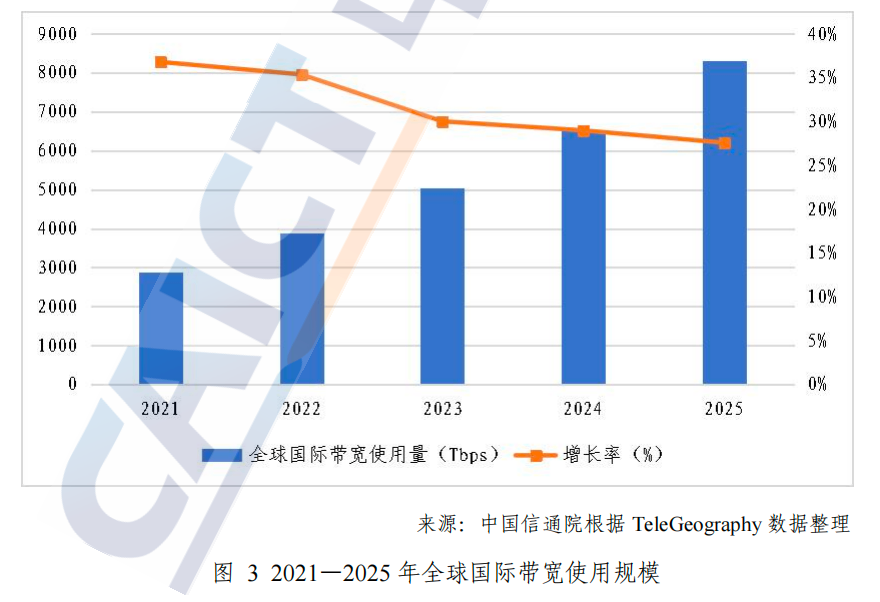
Accompanied by the accelerated construction of global international submarine cables, the scale of international maintains high-speed growth. The core engine role of Asia, Europe, and America is increasingly prominent, and Asia exhibits the "double high" characteristics of both total growth and growth rate. to statistics, the global international bandwidth usage in 2025 has reached 8309 Tbps, with a compound annual growth rate (CAGR) of over 0% from 2021 to 2025. It is expected that the global international bandwidth usage will reach 26552 Tbps in 030, with a CAGR of approximately 26% from 2026 to 2030.
Here is the formal English version of the text:
**Analysis of Global Bandwidth Demand and Submarine Cable Integration Market**
Regarding the structure bandwidth demand, over the past five years, leading internet enterprises and cloud service providers (content providers) have actively expanded their global bandwidth resources to optimize their international business layouts and market. By actively participating in international submarine cable construction and bandwidth leasing, these entities have accelerated the structural adjustment of global bandwidth resource allocation, facilitating a rapid transition toward a "content-driven bandwidth distribution paradigm. Statistics indicate that by 2025, the international bandwidth usage of content providers has surged to 6,262 Tbps, representing a growth exceeding 45%.
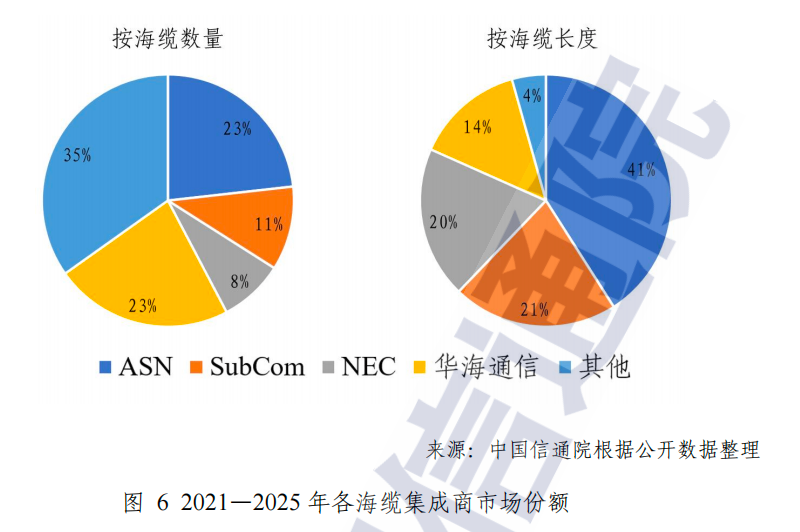
In terms of the supplier landscape, the submarine cable integration market continues to be dominated by four major global players. Currently, only a limited number of enterprises the capability for cross-regional, end-to-end submarine cable delivery. Consequently, the market structure remains relatively stable, led by the American firm SubCom, the French company ASN the Japanese firm NEC, and China's HMN Tech. To date, SubCom has delivered over 200 submarine cable projects with a total length exceeding 1 million; ASN has delivered more than 140 projects totaling approximately 850,000 kilometers; NEC has deployed over 450,000 kilometers of cables; and since its establishment in 2008, HMN Tech has undertaken over 180 projects with a contracted delivery length of 130,00 kilometers. Among the 120 submarine cable systems delivered globally between 2021 and 2025, HMN Tech, ASN, SubCom, and accounted for 23%, 23%, 11%, and 9% of the total number of deliveries, respectively. In terms of delivery length, their respective shares 14%, 41%, 21%, and 20%.
The report points out that submarine cable integrators dominate core technical equipment. The core equipment of submarine cables serves as the "mo" for integrators. Currently, the core technologies of submarine line repeaters, submarine line branchers, as well as open submarine cable access equipment, remote power supplies, and network management are mainly controlled by four integrators: NEC, SubCom, ASN, and Huahai Communication.
In the manufacturing segment of submarine optical cables, the market is mainly dominated companies such as Nexans (France/Norway), Prysmian (Italy), NEC (Japan), ASN (France), Hengtong Huahai, and ZTT. Major enterprises engaged in comprehensive competition based on their technology, production capacity, and project resources, with the industry as a whole accelerating technological iteration and global capacity expansion amidst fierce competition.
The also mentions that the breakthrough development and global deployment of artificial intelligence technology are profoundly reshaping the scale, structure, and distribution characteristics of international data traffic, driving international bandwidth demand into a historic of explosive growth. On one hand, the explosive growth of a new round of generative AI, particularly the large-scale application of AI large models, brings massive AI traffic demand through human- and agent-to-agent interactions. AI services are becoming a new business track leading regional traffic growth after internet platforms, driving submarine cables to expand from carrying information connectivity and data to AI interaction, bringing new incremental business demand to international submarine cable construction. It is estimated that the per-fiber capacity of an ALC submarine cable is 27Tbps which can transmit over 80 billion tokens per second based on industry equivalent traffic conversion.
The report also notes that the design lifespan of submarine optical cables is typically 25. Based on this, it is estimated that a large number of submarine cables will reach their design lifespan within the next five to ten years, and the global submarine cable market will maintain steady replacement of old and new cables, leading to a stable increase in demand for new submarine cable construction. According to incomplete statistics, it is estimated that between 2026 2030, 63 submarine cables reaching their retirement age will account for approximately 270,000 kilometers; between 2031 and 035, 83 submarine cables reaching their retirement age will account for approximately 200,000 kilometers. Regionally, the number of submarine optical cables their retirement age within Asia and Europe will account for more than 50% of the total in the next decade, making them the "main battlefield" for the replacement of international cables.












 Record Number:鲁ICP备2022038891号-2