On September 14, during the 27th China International Optoelectronic Exposition (CIOE) held in Shenzhen, C114, in with CIOE, hosted the "AI New Fiber Optic Applications Forum." Under the theme "Light Inspires Intelligence, Fiber Connects the Future," the forum on core topics including high-density optical interconnects for AIDC, hollow-core fiber, G.654.E trunk deployment, as well as and maintenance.
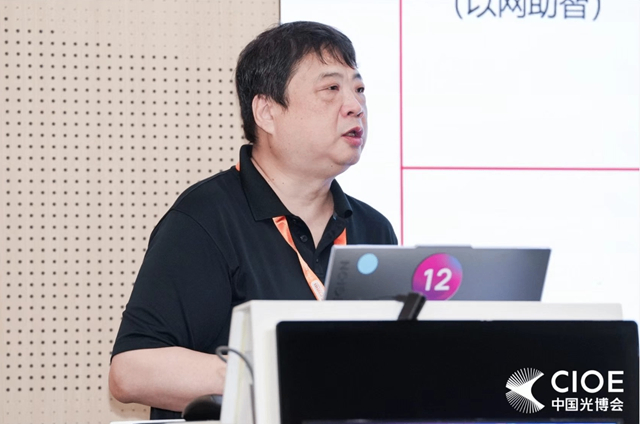
Wang Guangquan, Chief Engineer of China Unicom Research Institute, was invited to attend the conference and delivered a keynote titled "China Unicom's Development Practices in New Optical Fiber Technology". In his report, Wang Guangquan systematically reviewed China Unicom's layout and reflections on optical fiber technology, and made judgments on the evolution path of new optical fibers facing the AI era.
Wang Guangquan pointed out that over the past 20 years the improvement of spectral efficiency has dominated the main theme of high-speed transmission development in optical networks. However, constrained by the Shannon limit, increasing the speed of single wavelength will occupy a wider spectrum. To continuously double the capacity, it is necessary to expand the spectrum to the C L band, and even the S L band. Optical fibers and cables are the foundation of optical transmission systems, making their technology selection and evolution strategy particularly crucial.
G.654. Optical Fiber: Building a New Foundation for the Backbone Network
Facing the explosive growth in capacity demand, G.654.E optical fiber, which combines large effective area with low loss characteristics, has become the preferred choice. Wang Guangquan introduced that China Unicom has actively promoted the introduction of optical fibers with both large area and low loss characteristics (G.654.E) in terrestrial high-speed transmission systems, and collaborated with domestic and international industry chains to complete the and normalization of key parameter indicators for G.654.E optical fiber. Currently, G.654.E optical fiber has been widely deployed the backbone networks of the three major domestic operators and overseas, supporting the "East Data, West Computing" strategy and the reshaping and renewal of the "Eight Vertical and Horizontal" optical cable network.
As metropolitan networks develop towards higher speeds such as 800G/T-bit, G.654.E fiber also has good application prospects. Wang Guangquan stated that through multiple key verification tests, G.654.E optical fiber shows significant advantages in extending the un relay transmission distance. It not only supports point-to-point WDM direct connection and flexible ROADM networking, but also achieves the integration of metropolitan and backbone cables, facilitating end-to-end service configuration.
Of course, large-scale promotion still requires a cost-benefit trade-off. Wang Guangquan objectively analyzed that the total cost of backbone optical networks, the cost of optical fiber accounts for a small proportion. Adopting G.654.E only increases the total cost 10%-20% compared to G.652.D, and compared to the increased cost of electrical repeater equipment, the comprehensive cost advantage is; however, in metropolitan networks, the cost of optical fiber accounts for a large proportion of the total cost, so the cost of G.654.E needs to be further reduced to avoid a significant increase in the total cost.
In the 800G transmission verification of G.654. optical fiber, China Unicom, in collaboration with the industry chain, has achieved a key breakthrough. Measured data show that the 800G signal based on C L band (12THz) can achieve a real-time transmission distance of 1050km on G.654.E fiber and after reserving engineering margins, it can still support 420-440km metropolitan transmission; in the extreme scenario of the S C L band combined with BDFA and TDFA hybrid amplification technology, it also achieved 300km real-time transmission. In addition, the verification also shows that compared with G.654.E fiber, the downward shift of the cutoff wavelength of G.654.E fiber has almost no difference in S-band performance, and the MPI penalty is less than 0.2dB.
Single-mode single-core approaches the limit, hollow-core fiber makes its debutCurrently, the indicators of single-mode single-core fiber have approached the theoretical limit—the loss limit is about 0.14dB/km, the transmission speed can only reach 2/3 of the speed of light in a vacuum. The expansion of optical networks urgently needs to open up a new dimension. Guangquan pointed out that the future evolution direction will focus on utilizing space-division multiplexing (SDM) fiber in the spatial dimension, or air-core fiberHCF) with air as the medium.
Among them, hollow-core fiber, with its four major characteristics of ultra-low latency (reduced by 3%), ultra-low loss (below 0.1dB/km), ultra-low dispersion (2-4ps/nm/km), and ultra-low (1000 times lower than solid-core fiber), has become a key transmission medium for AI computing networks, high-frequency trading, quantum, and G.
On the technical level, the structure of hollow-core fibers is continuously innovating, and the attenuation coefficient is steadily decreasing: has achieved an attenuation of less than 0.1 dB/km for large-core hollow-core fibers within the 17.9 THz range, YOFC has achieved a minimum attenuation of 0.04 dB/km. The drawing length of a single hollow-core fiber preform has reached 9.2 km, bringing the dawn of industrial-scale mass production.
In terms of live network deployment, China Unicom has actively engaged in the exploration of-core fibers in live networks. Following the completion of the first 4.2 km pilot in Nanjing, Jiangsu, and the 30 km cross- commercial interconnection from Shenzhen to Hong Kong in October 2025, it completed a 7.5 km interconnection verification in a core machine room in Hangzhou in 2026.
Through short-distance optical cable routing pilots, China Unicom has accumulated practical experience in the entire process of hollow-core fiber cabling laying, splicing, and maintenance. It has also verified technical requirements such as live network splicing, OTDR testing, and cabling/termination. Meanwhile, it has issues that need improvement, including OTDR splice loss measurement, precise attenuation coefficient measurement, multi-core cabling performance, and water ingress detection technology.
Despite the broad, large-scale commercialization of hollow-core fibers still faces multiple obstacles: First, data center adaptation is difficult. Existing large-core fibers struggle to meet dense needs and suffer from mode field mismatch with multi-mode VCSEL lasers, resulting in high modification costs and long cycles. Second, standards are lacking. The ITUT only officially initiated the technical report in July 2026, and the international standard system is still in its infancy. Third, ecosystem reconstruction is difficult. challenges remain in terms of transmission performance, mechanical properties, environmental applicability, and engineering application performance, making the road ahead long and arduous
Multi-core fiber: Mature technology gradually moving towards application
Compared to hollow-core fiber, multi-core fiber (F) technology is more mature and is gradually moving towards practical application.
Wang Guangquan introduced that the global multi-core fiber industry chain is increasingly improving, live network cases continuously emerging: Google and NEC are collaborating to build a transoceanic submarine cable based on 2-core multi-core fiber, expected to be by the end of 2025; Sumitomo of Japan laid the world's first multi-core fiber optic cable as early as 209. Domestically, in 2025, Sun Yat-sen University reported the world's longest multi-core fiber submarine cable based on claddingpumped multi-core EDFA for the first time, using 7-core weakly coupled fiber with a total length of 140 km. China Information Communication Technology (CETC), YOFC, and Peng Cheng Laboratory achieved 24-core weakly coupled 10.3 km, 5.29/s transmission; China Mobile and YOFC achieved 7-core weakly coupled 990.64 km, 256 Tb/s live transmission, etc.
China Unicom has also achieved remarkable results in the field of multi-core fiber. Based on the C L band integrated core-pumped amplifier, it achieved real-time transmission of 300 km for 4-core weakly coupled fiber, using 400G and 80G OTU to complete capacity transmissions of 115.2 Tb/s and 230.4 Tb/s respectively, verifying the realtime transmission performance of weakly coupled four-core fiber compatible with traditional G.654.E single-mode fiber and having a cladding diameter of 12 μm; after 300 km of transmission, core crosstalk had no significant impact on transmission performance.
In terms of standardization, ITU-T SG1 officially launched multi-core fiber (MCF) standardization (G.smmcf) and corresponding test methods (revision of G.650.2) the plenary meeting in March 2025; the plenary meeting in October 2025 split G.smmcf into two standards: G.52 compatible and G.654 compatible. Domestically, CCSA TC6 WG3/4/1 has also completed research reports on space-divisioning fiber characteristics, optical devices, and transmission technologies respectively.
In terms of application scenarios, multi-core fibers, combined with MPO and fan-in/fan-out devices, can increase connection density within the same footprint for short-distance inter-rack interconnection inside data centers, significantly optimizing the utilization rate of optical fiber resources. However, Wang Guang also pointed out that long-distance transmission applications of multi-core fibers still need to address numerous technical and engineering issues, such as complex structural design and long-distance, FIFO, link amplification and equalization, crosstalk characterization and suppression, MIMO DSP implementation under strong and weak coupling, and engineering splicing.
At the end of speech, Wang Guangquan concluded: The upgrading of optical fibers and cables must focus on future ultra-high-speed transmission needs, and considering that the service life of fibers reaches 15-20 years or more, extreme caution is required. G.654.E fiber, which features both low nonlinear effects and low attenuation coefficient, is the preferred choice for 400G backbone networks; its large-scale deployment in backbone networks must be accelerated to pave the way even larger-scale construction. Future metropolitan area network rate upgrades could consider the combination of G.654.E fiber and 800G, while the potential applications of new types of fibers such as hollow-core fibers and multi-core fibers, "there is still a long way to go, and killer application need to be found to overcome the corresponding technical challenges."













 Record Number:鲁ICP备2022038891号-2